
Author: Sampoorna Mettilda
Website: infoplay.xyz
If you are new to the stock market, one of the first terms you will hear is intraday trading. Many beginners want to know whether intraday trading can help them earn daily income. Some people believe it is easy money, while others lose money quickly because they enter without proper knowledge.
So, what exactly is intraday trading?
In simple words, intraday trading means buying and selling stocks on the same day before the market closes. You do not keep the shares overnight. The goal is to earn profit from short-term price movement during market hours.
In India, the stock market usually opens at 9:15 AM and closes at 3:30 PM. Intraday traders try to capture opportunities within this time.
This guide will explain everything in simple English so beginners can understand clearly.
What Is Intraday Trading?
Intraday trading is also called day trading.
It means:
- Buying shares and selling them on the same day
- Or selling first and buying later on the same day (short selling in some segments)
The main purpose is to earn profit from price fluctuations happening within a few minutes or hours.
For example:
If you buy a stock at ₹500 in the morning and sell it at ₹520 in the afternoon, your profit is ₹20 per share (excluding charges).
Unlike delivery trading, you do not hold the stock for days, weeks, or months.
You can also read our beginner guide on Difference Between Investing and Trading at infoplay.xyz for better understanding.
Quick Comparison Table
| Feature | Intraday Trading | Delivery Trading |
|---|---|---|
| Holding Period | Same day only | More than one day |
| Risk Level | High | Moderate |
| Profit Speed | Fast | Slow |
| Capital Needed | Lower (Margin available) | Higher |
| Suitable For | Active traders | Long-term investors |
| Overnight Holding | No | Yes |
What Is an Example of Intraday Trading?
Let us understand with a simple example.
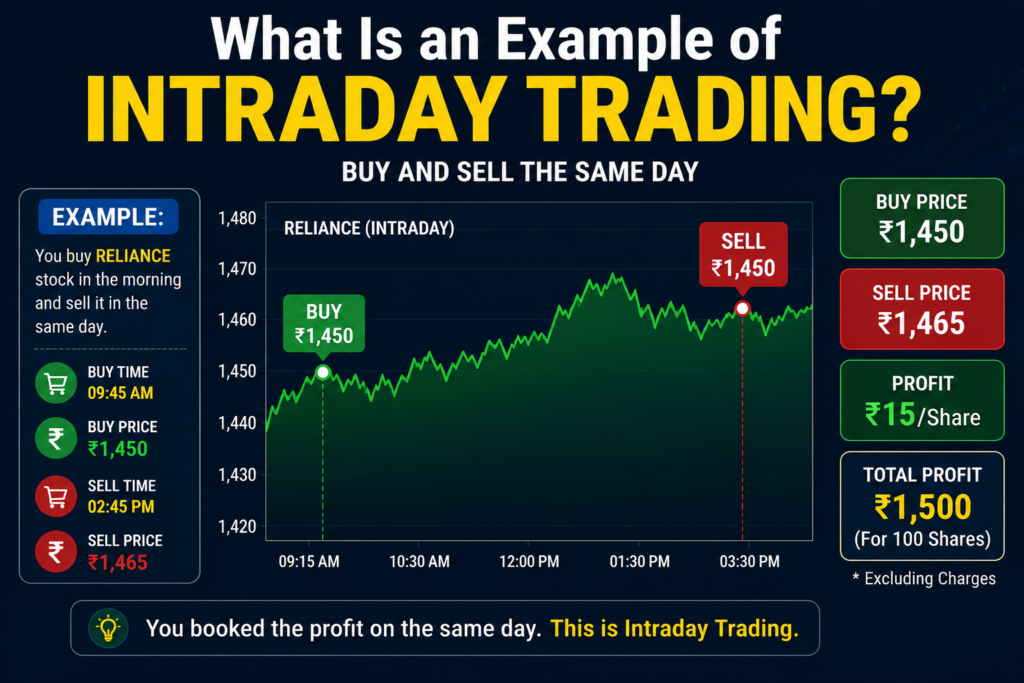
Suppose you choose Reliance Industries stock for intraday.
Example:
- Buy Price = ₹1,450
- Quantity = 100 shares
- Total Value = ₹1,45,000
After 2 hours:
- Sell Price = ₹1,465
Profit Calculation:
₹15 profit × 100 shares = ₹1,500 profit
After brokerage, taxes, and charges, the final profit may be slightly lower.
This is called intraday trading because both buy and sell happened on the same day.
Similarly, if the stock falls to ₹1,435, you may face a loss.
That is why stop loss is very important.
You may also like our article on How to Select Stocks for Intraday Trading at infoplay.xyz
Which Is Better, Delivery or Intraday?
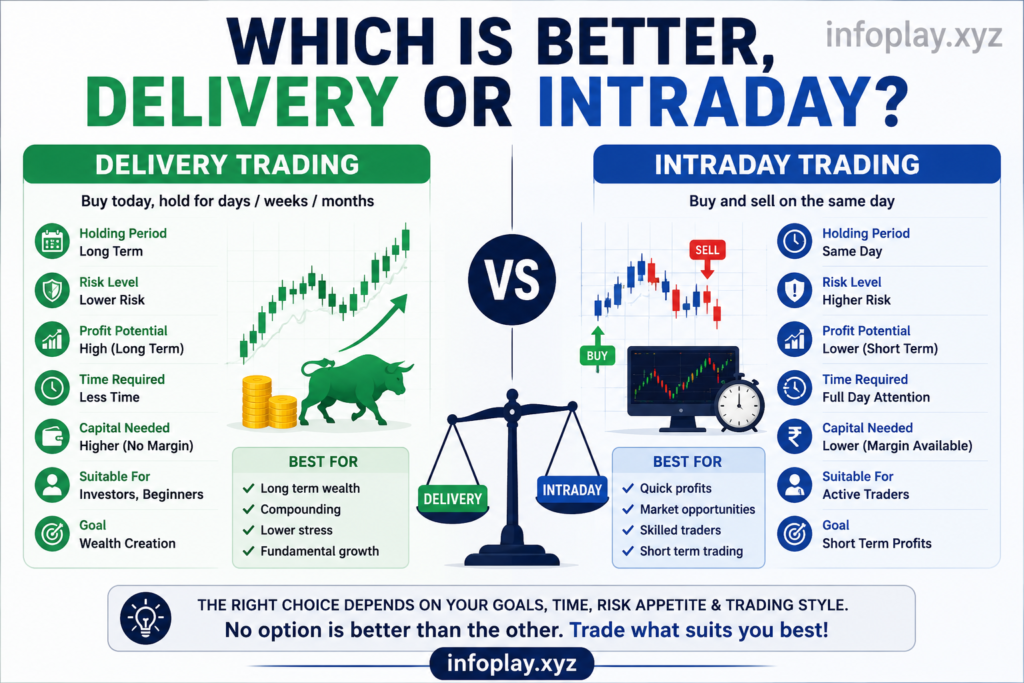
There is no single answer because it depends on your goals.
Delivery Trading Is Better If:
- You are a beginner
- You have a full-time job
- You want lower stress
- You prefer long-term investing
- You do not want to watch charts all day
Intraday Trading Is Better If:
- You can monitor the market actively
- You understand price action
- You know risk management
- You can handle fast decisions
- You have discipline
Simple Truth:
For most beginners, delivery trading is safer than intraday trading.
Intraday may look attractive because profits can be quick, but losses can also happen very fast.
How Risky Is Intraday Trading?
Intraday trading is considered high risk.
Why?
Because prices move very quickly. Sometimes a stock can move sharply within minutes due to:
- News
- Global market movement
- FII/DII activity
- RBI announcements
- Crude oil changes
- Gift Nifty movement
Even experienced traders can face losses.
Major Risks Include:
- Sudden market reversal
- Emotional trading
- Overtrading
- High leverage
- Lack of stop loss
- Poor stock selection
That is why professional traders focus more on protecting capital than chasing profit.
What Are the Mistakes of Intraday?
Most beginners lose money because of common mistakes.
Top Intraday Trading Mistakes
1. Trading Without a Stop Loss
This is the biggest mistake.
Without stop loss, one bad trade can wipe out many good trades.
2. Overtrading
Taking too many trades in one day creates confusion and emotional mistakes.
Sometimes the best trade is no trade.
3. Following Tips Blindly
Many people depend on Telegram tips or random WhatsApp groups.
This is dangerous.
Always trust your own analysis.
4. Using Too Much Leverage
Broker margin can look attractive, but high leverage increases risk heavily.
5. Revenge Trading
After one loss, many traders try to recover immediately and lose even more.
6. Ignoring Market Trend
Buying in a strong downtrend or selling in a strong uptrend creates problems.
Trend matters.
7. No Trading Journal
Without recording mistakes, improvement becomes difficult.
Who Cannot Do Intraday Trading?
Intraday trading is not suitable for everyone.
Avoid Intraday If:
- You cannot control emotions
- You panic easily
- You expect quick riches
- You do not have time to monitor the market
- You are using borrowed money
- You cannot accept losses
- You are still learning basic market concepts
Many people think intraday is a shortcut to easy money.
It is not.
It requires patience, discipline, and experience.
Why Do People Lose Money in Intraday?
This is the most important question.
People usually do not lose because the market is bad.
They lose because of poor decisions.
Main Reasons People Lose
No Proper Strategy
Random buying and selling is gambling, not trading.
Lack of Discipline
Even a good strategy fails without discipline.
Fear and Greed
These two emotions destroy most traders.
- Fear causes early exits
- Greed causes late exits
No Risk Management
Professionals think first about loss.
Beginners think only about profit.
That is the difference.
Unrealistic Expectations
Trying to double money quickly usually ends badly.
Consistency matters more than speed.
Can I Make a Living from Intraday Trading?
Yes, but not immediately.
Many people ask:
“Can I leave my job and depend only on intraday trading?”
The honest answer is:
Only after years of experience and consistent results.
To Make a Living from Intraday, You Need:
- Strong strategy
- Good capital
- Emotional control
- Risk management
- Consistency
- Patience
- Real market experience
Most successful traders first survive, then grow.
They do not chase fast profits.
Important Advice
Never depend on intraday trading for monthly expenses in the beginning.
First learn. Then practice. Then scale slowly.
Best Tips for Beginners
Follow These Rules
- Start with small capital
- Use strict stop loss
- Trade only 1–2 good setups
- Avoid overtrading
- Learn price action
- Track Gift Nifty daily
- Watch FII and DII activity
- Maintain a trading journal
- Focus on consistency
- Never trade emotionally
These simple habits create long-term success.
Internal Resources You Should Read
To improve your trading knowledge, also read:
- What is NSE and BSE in Stock Market — infoplay.xyz
- Difference Between Nifty and Sensex — infoplay.xyz
- How to Start Trading Stocks for Beginners — infoplay.xyz
These will help you build strong basics before entering intraday trading.
FAQ Section
Is intraday trading good for beginners?
It is better for beginners to start slowly. First learn basics, then practice with small capital.
How much money is needed for intraday trading?
You can start with small capital like ₹5,000 to ₹10,000, but proper risk management is more important than capital size.
Can I do intraday trading on mobile?
Yes, many brokers like Angel One, Zerodha, and Dhan offer mobile apps for intraday trading.
Is intraday trading taxable?
Yes, profits from intraday trading are taxable under business income rules in India.
Which indicator is best for intraday?
There is no perfect indicator, but many traders use:
- VWAP
- RSI
- MACD
- Moving Averages
- Volume Analysis
- ATR
Indicators should support strategy, not replace it.
Conclusion
Intraday trading can be profitable, but it is not easy money.
It requires:
- Skill
- Patience
- Discipline
- Risk control
- Experience
If you enter the market without learning, losses are very likely.
But if you treat trading like a serious profession and focus on consistency, intraday trading can become a powerful skill.
Start small.
Learn daily.
Protect your capital.
That is the real path to success in the stock market.
Disclaimer
This article is for educational purposes only and should not be considered financial advice, stock recommendation, or trading signals. Stock market investments and intraday trading involve risk. Please consult your financial advisor before making investment decisions. We do not guarantee profits or protection from losses.