
Many beginners in India hear the words Nifty and Sensex every day. News channels say, “Nifty is up today” or “Sensex fell by 500 points.” But many people do not clearly understand what these two words mean.
In simple words, both Nifty and Sensex are stock market indices. They help us understand how the Indian stock market is performing. If these indices are going up, it usually means many top companies are doing well. If they are falling, it usually means the market is weak.
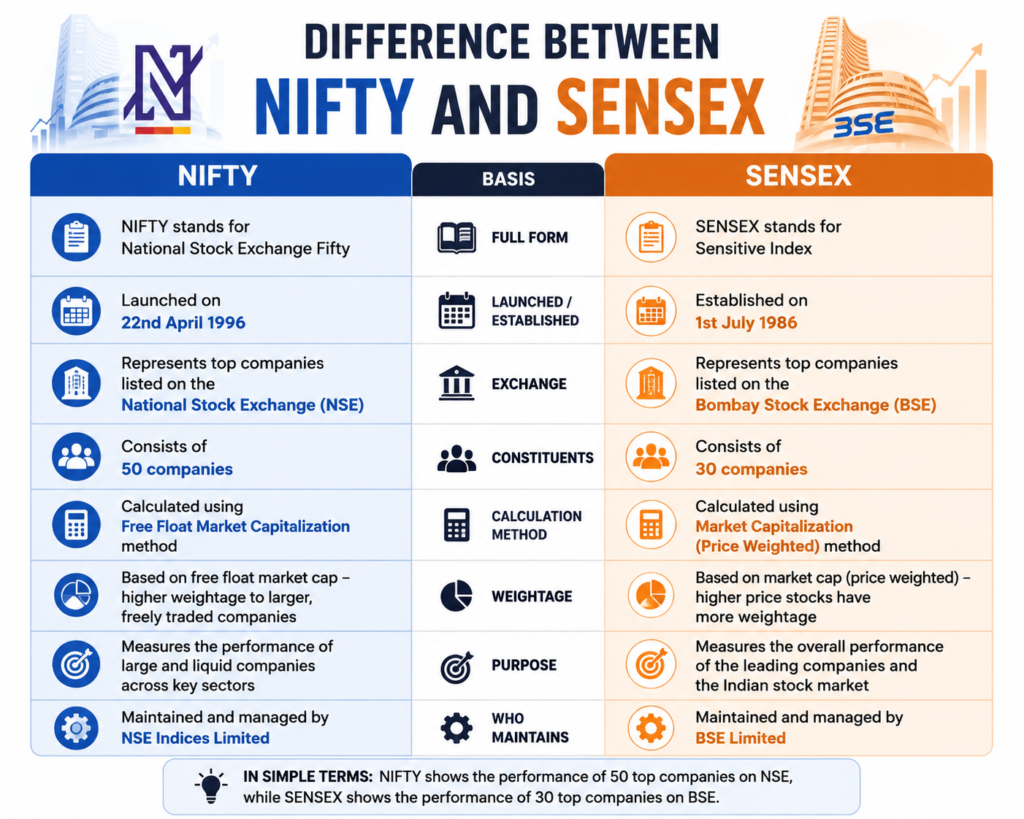
Nifty and Sensex are not single companies. They are groups of top companies. Nifty tracks 50 major companies listed on the National Stock Exchange, while Sensex tracks 30 major companies listed on the Bombay Stock Exchange. Nifty 50 has 50 constituents and a base date of November 3, 1995, with a base value of 1000. Sensex has 30 stocks, and its base year is 1978–79 with a base value of 100.
This guide explains Nifty vs Sensex in very simple English. It is useful for students, beginners, investors, and anyone who wants to understand the Indian share market.
Disclaimer: This article is only for educational purposes. It is not financial advice. Please talk to a certified financial advisor before investing your money.
Difference between Nifty and Sensex
Nifty and Sensex both show the condition of the Indian stock market, but they are not the same. The biggest difference is the number of companies they track.
Nifty tracks 50 large companies from different sectors. Sensex tracks 30 large and well-known companies. Because Nifty has more companies, it gives a slightly wider view of the market.
Nifty vs Sensex Comparison Table
| Point | Nifty | Sensex |
|---|---|---|
| Full Name | Nifty 50 | BSE Sensex |
| Stock Exchange | NSE | BSE |
| Number of Companies | 50 companies | 30 companies |
| Base Date / Year | November 3, 1995 | 1978–79 |
| Base Value | 1000 | 100 |
| Market Coverage | Broader market view | Older benchmark view |
| Best Known For | Wider diversification | Oldest popular Indian index |
| Good For | Beginners, ETFs, index funds, derivatives | Market news and long-term benchmark tracking |
Main Differences in Simple Words
- Nifty has 50 companies, so it covers more businesses.
- Sensex has 30 companies, so it is a smaller basket.
- Nifty belongs to NSE, while Sensex belongs to BSE.
- Sensex is older than Nifty.
- Nifty is commonly used for index funds, ETFs, and futures/options trading.
- Sensex is very popular in news because it is one of India’s oldest market indices.
Both indices include strong companies from sectors like:
- Banking
- IT
- Energy
- FMCG
- Auto
- Telecom
- Pharma
- Infrastructure
The main job of both indices is to show the health of the stock market. They do not show every company in India, but they show the movement of some of the largest and most important companies.
Which is better, Sensex or Nifty?
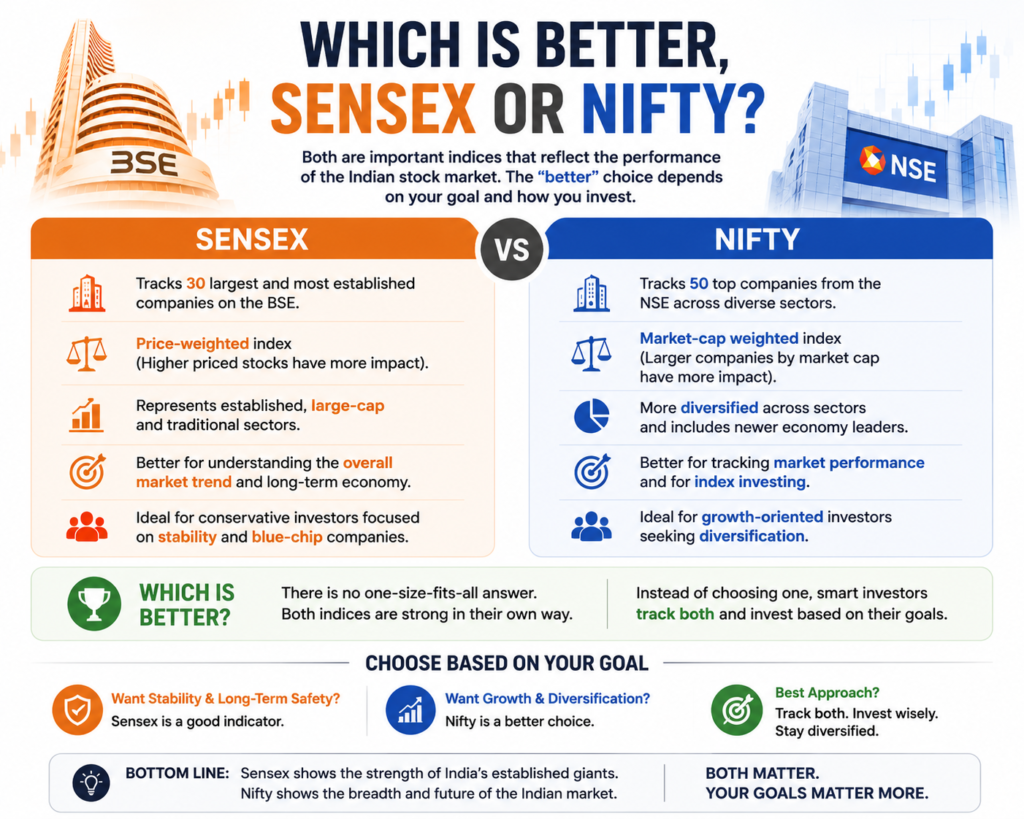
There is no single answer because both are useful. The better choice depends on what you want to do.
For a beginner, Nifty may feel easier to follow because it has 50 companies and gives a broader market picture. Many mutual funds and ETFs also follow Nifty-based indices.
Sensex is also very important. It is older and trusted. It is often used in news headlines to show how the Indian stock market is moving. Many people still see Sensex as a classic symbol of the Indian market.
Choose Nifty If:
- You want a broader view of the market.
- You like index funds or ETFs.
- You want exposure to 50 large companies.
- You follow NSE-based trading.
- You want better diversification than a 30-stock basket.
Choose Sensex If:
- You want to track 30 top companies.
- You like older and established market benchmarks.
- You follow BSE market updates.
- You want a simple index with fewer companies.
- You are reading long-term Indian market history.
Simple Answer
For most beginners, Nifty is often more practical because it covers more companies and is widely used in index investing. But Sensex is also important because it is a trusted and older benchmark.
So, instead of asking “Which is better?”, a better question is:
Which one matches my goal?
If your goal is broad market exposure, Nifty may be better. If your goal is to track an old and famous Indian market index, Sensex is useful.
Why do people prefer Nifty over Sensex?
Many people prefer Nifty because it gives a wider market view. Since Nifty tracks 50 companies, it includes more stocks than Sensex. This means one company has less power to move the whole index.
For example, if one company in Sensex performs badly, the effect may be stronger because Sensex has only 30 companies. In Nifty, the impact may be slightly lower because the index has 50 companies.
Reasons People Prefer Nifty
People may prefer Nifty because:
- It has more companies.
- It gives better diversification.
- It is widely used in index funds and ETFs.
- It is very popular among traders.
- It gives a broader view of large Indian companies.
- It covers more sectors.
- It is useful for beginners who want to understand market movement.
Nifty and Index Funds
Many investors do not want to pick single stocks. They prefer index funds. An index fund tries to copy an index like Nifty 50. When you invest in a Nifty 50 index fund, your money is spread across companies that are part of the index.
This may reduce the risk of depending on only one company. But it does not remove all risk. The stock market can still go up and down.
Nifty Is Popular in Trading
Nifty is also very popular in the futures and options market. Many traders follow Nifty because it has high activity and strong market participation.
But beginners should be careful. Trading is risky. Long-term investing is usually safer than short-term guessing.
Main Point
People prefer Nifty because it is broader, more diversified, and widely used for investing and trading. That does not mean Sensex is bad. It only means Nifty may be more useful for many modern investors.
Why is Sensex value more than Nifty?
Many beginners ask this question:
If Nifty has 50 companies and Sensex has 30 companies, why is Sensex number higher?
This is a good question. The answer is simple:
Sensex and Nifty started from different base years and different base values.
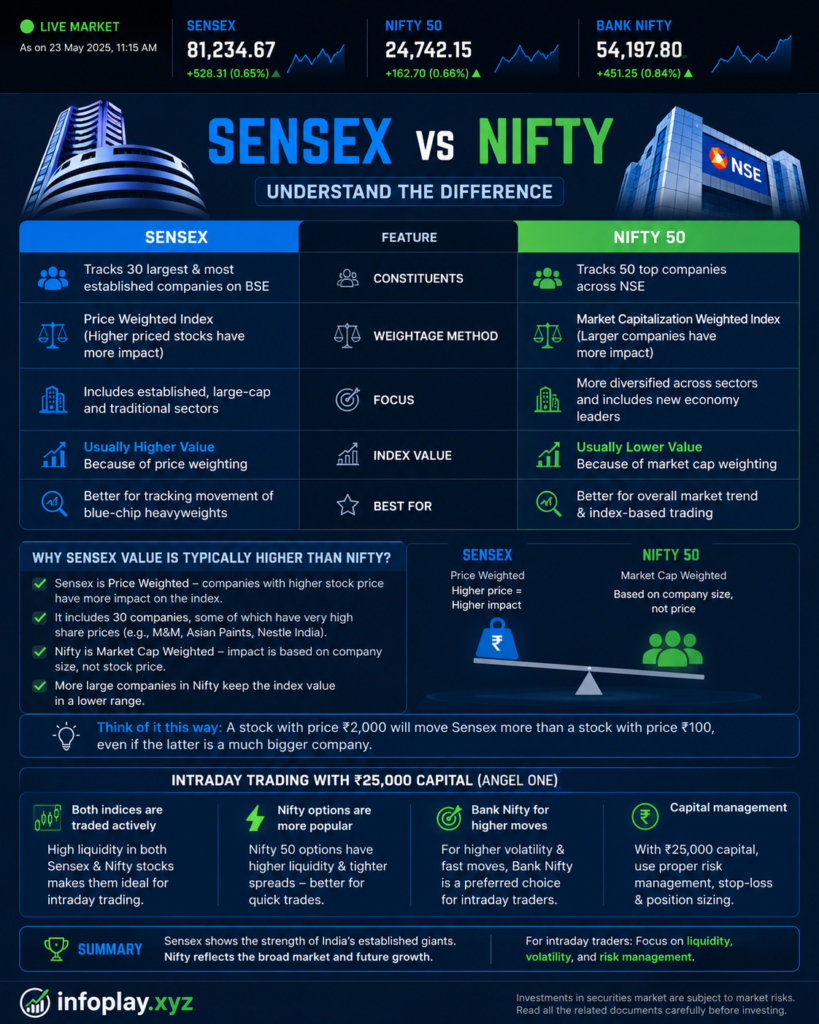
Sensex started with a base year of 1978–79 and a base value of 100. Nifty 50 started later, with a base date of November 3, 1995, and a base value of 1000. Because they started at different times and different values, their numbers cannot be compared directly.
Simple Example
Imagine two students start saving money.
| Person | Started Saving | Starting Amount |
|---|---|---|
| Person A | 1978 | ₹100 |
| Person B | 1995 | ₹1000 |
After many years, Person A may have a bigger total amount because they started much earlier. That does not mean Person A is always better. It only means the starting point was different.
The same idea applies to Sensex and Nifty.
Sensex Number Is Higher Because:
- Sensex started earlier.
- Its base year is older.
- It has had more years to grow.
- Its calculation history is different.
- The index level is not the same as market quality.
Important Point
A higher index number does not mean that Sensex is better than Nifty. It only means the index has a different base and history.
So, do not choose an index just because the number is higher. You should look at:
- Your goal
- Your time period
- Risk level
- Diversification
- Fund cost
- Past consistency
- Investment method
Where to invest, Nifty or Sensex?
You cannot directly buy Nifty or Sensex like a normal stock. You can invest through mutual funds, index funds, or ETFs that follow these indices.
For beginners, index funds are often easier to understand. They do not require you to choose individual stocks. The fund simply follows the index.
Ways to Invest
You can invest in Nifty or Sensex through:
- Index mutual funds
- Exchange Traded Funds
- SIP in index funds
- Long-term mutual fund plans
Nifty May Be Suitable If:
- You want wider exposure.
- You want 50-company diversification.
- You want a popular index fund option.
- You are investing for long-term wealth building.
- You want to follow the broader large-cap market.
Sensex May Be Suitable If:
- You want exposure to 30 established companies.
- You like a simple and old benchmark.
- You want to track BSE’s main index.
- You prefer a smaller group of blue-chip companies.
Beginner-Friendly Investment Idea
For many beginners, a low-cost Nifty 50 index fund can be a simple starting point. It gives exposure to 50 top companies and is easy to track.
But Sensex index funds can also be good for long-term investors. The difference in returns between Nifty and Sensex may not always be very large because many top companies are common in both indices.
Things to Check Before Investing
Before you invest, check:
- Expense ratio
- Tracking error
- Fund size
- Fund house reputation
- Your investment goal
- Your risk capacity
- Your time period
- Exit load, if any
- Tax rules
Long-Term View
Stock market investing works better when you stay patient. Short-term ups and downs are normal. If you invest through SIP, you can invest small amounts regularly.
A beginner should not invest all money at once without planning. It is better to build slowly and learn.
Nifty vs Sensex: Quick Summary
| Question | Simple Answer |
|---|---|
| Which has more companies? | Nifty |
| Which is older? | Sensex |
| Which gives broader exposure? | Nifty |
| Which is more common in news? | Both, but Sensex is very popular in headlines |
| Which is better for beginners? | Nifty may be easier for broad exposure |
| Can I directly buy Nifty or Sensex? | No, you invest through index funds or ETFs |
| Is Sensex better because its value is higher? | No, the base year and calculation are different |
Benefits of Understanding Nifty and Sensex
Understanding Nifty and Sensex helps you read market news better. It also helps you make smarter investment choices.
When you understand these indices, you can:
- Know if the market is strong or weak.
- Understand news headlines.
- Compare index funds.
- Avoid confusion about market points.
- Learn basic stock market language.
- Make better long-term plans.
For example, if Nifty and Sensex both fall, it may show weakness in the overall market. If both rise, it may show positive market mood. But you should not make big investment decisions only by looking at one day’s movement.
Markets move daily. Good investing needs patience, research, and discipline.
Common Mistakes Beginners Make
Many beginners make simple mistakes when learning about Nifty and Sensex.
Avoid These Mistakes
- Thinking Sensex is better only because the number is higher.
- Thinking Nifty is risk-free.
- Investing without understanding the fund.
- Looking only at one-day market movement.
- Copying others without research.
- Doing short-term trading without knowledge.
- Ignoring costs like expense ratio.
- Investing emergency money in the stock market.
The stock market can create wealth, but it needs time. It is not a quick money machine.
Final Thoughts
Nifty and Sensex are both important parts of the Indian stock market. Nifty tracks 50 large companies on NSE, while Sensex tracks 30 large companies on BSE. Nifty gives a broader market view, while Sensex is an older and trusted benchmark.
For beginners, Nifty may be more useful because it covers more companies and is widely used in index funds and ETFs. But Sensex is also valuable because it has a long history and represents many strong companies.
The best choice depends on your goal. If you want broad exposure, Nifty can be a good option. If you want to follow a classic Indian benchmark, Sensex is useful.
Always remember: investing should be done with planning, patience, and proper knowledge.
FAQ: Nifty vs Sensex
1. What is the main difference between Nifty and Sensex?
The main difference is the number of companies. Nifty tracks 50 companies listed on NSE, while Sensex tracks 30 companies listed on BSE.
2. Which is better, Nifty or Sensex?
Both are good. Nifty gives a broader market view because it has 50 companies. Sensex is older and tracks 30 established companies.
3. Why is Sensex higher than Nifty?
Sensex has a higher value because it started earlier and has a different base year and base value. The higher number does not mean it is better.
4. Can I invest directly in Nifty or Sensex?
No. You cannot directly buy the index. You can invest through index funds or ETFs that follow Nifty or Sensex.
5. Is Nifty safer than Sensex?
Nifty is more diversified because it has 50 companies. But it is not risk-free. Both can fall when the market is weak.
6. Is Sensex good for beginners?
Yes, Sensex is easy to understand because it tracks 30 large companies. But many beginners prefer Nifty index funds for broader exposure.
7. Which is better for SIP, Nifty or Sensex?
Both can be used for SIP through index funds. Many beginners choose Nifty 50 index funds because they are popular and broadly diversified.
8. Does Nifty give better returns than Sensex?
Returns can change over time. Since many top companies overlap, returns may sometimes be close. Always compare fund cost, tracking error, and long-term performance.
9. Is this article financial advice?
No. This article is for education only. Please consult a certified financial advisor before making investment decisions.