
What is NSE and BSE in the Stock Market? Hey there! If you’re just starting out in the stock market, you’ve probably heard the terms NSE and BSE thrown around a lot. They can sound a bit confusing at first, right? Don’t worry I’m going to explain everything in plain, easy to understand, like we’re chatting over a cup of tea. By the end of this article, you’ll know exactly what NSE and BSE are, how they work, and which one might be better for you as a beginner.
India has two big stock exchanges where people buy and sell shares of companies: the Bombay Stock Exchange (BSE) and the National Stock Exchange (NSE). Think of them as two giant marketplaces in Mumbai where thousands of companies’ shares are traded every day. Most big companies are listed on both, but they have some differences that can matter when you start investing or trading.
Before we dive deeper, if you’re completely new and want the absolute basics of how the stock market works, check out our beginner guide here: What is Stock Market? Beginner Guide. It’ll give you a super simple foundation.
What is the Bombay Stock Exchange (BSE)?
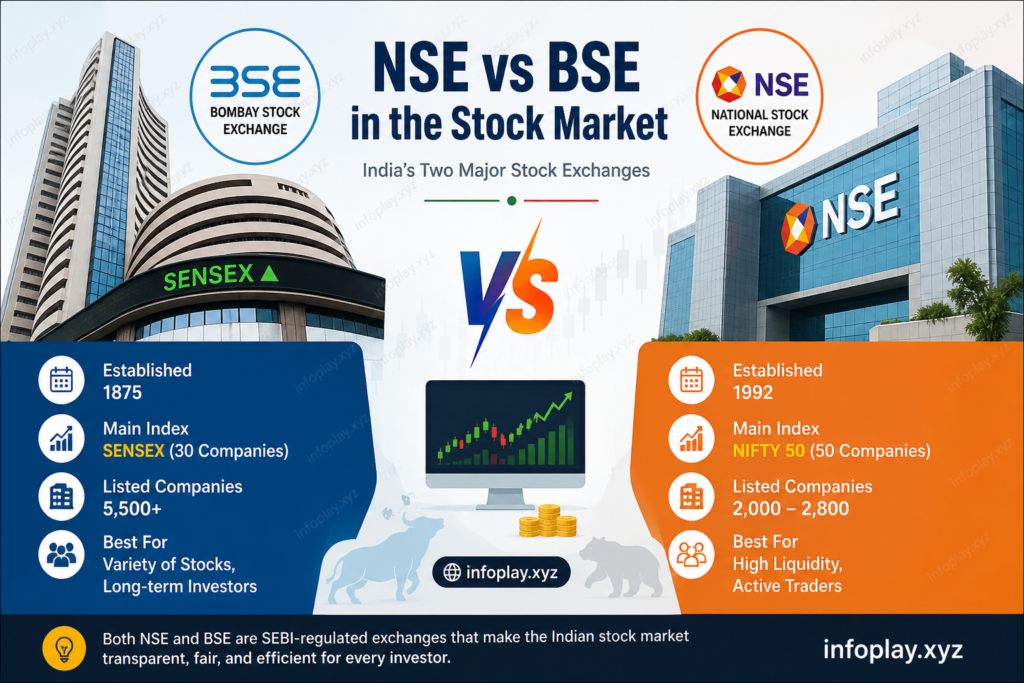
The BSE is the oldest stock exchange in Asia and one of the oldest in the world. It started way back in 1875 under a banyan tree in Mumbai (then called Bombay). Back then, stockbrokers would meet under that tree and shout out prices! Today, it’s a modern electronic exchange located on Dalal Street in Mumbai.

BSE’s famous index is called the Sensex (or S&P BSE Sensex). It tracks the performance of 30 of the biggest and most trusted companies in India. When people say “the market is up today,” they often mean the Sensex went higher.
BSE lists more than 5,500 companies way more than the NSE. That means you can find lots of smaller companies and unique stocks here that might not be as active on the other exchange. It’s like a huge supermarket with thousands of different items.
The BSE uses its own trading system called BOLT (BSE Online Trading). It’s reliable, but the trading volume (how many shares change hands every day) is usually lower than on the NSE.
If you’re someone who likes history and variety, BSE feels special because it has been part of India’s growth story for over 140 years.
What is the National Stock Exchange (NSE)?
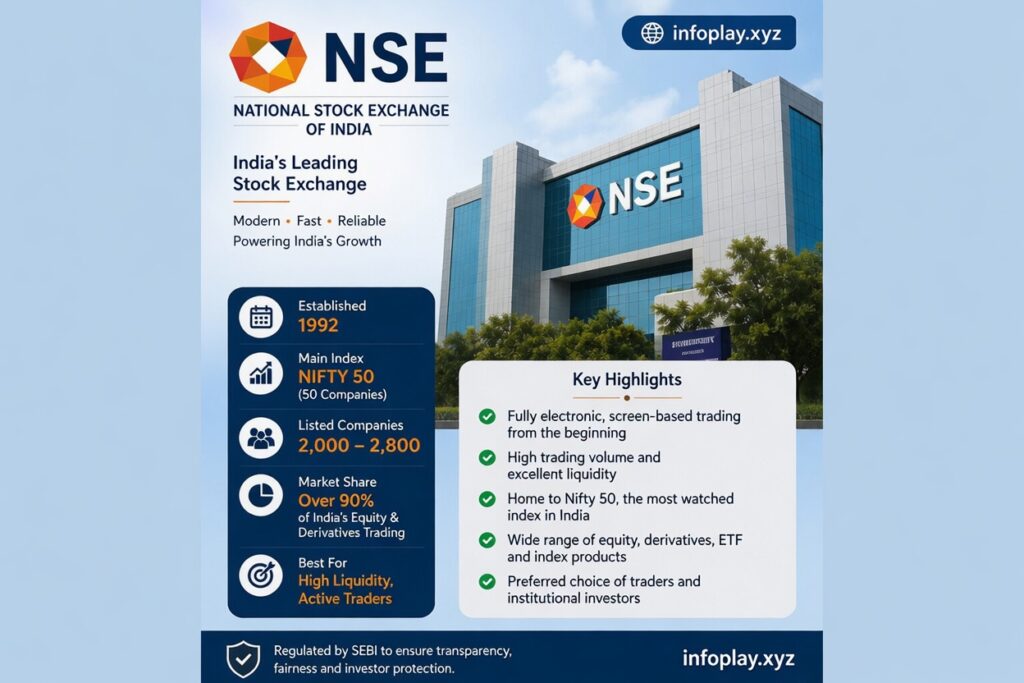
The NSE is much younger – it started in 1992 and began trading in 1994. It was India’s first fully electronic, screen-based stock exchange from day one. No shouting under trees here! Everything was modern and computerized right from the start.
The NSE’s main index is the Nifty 50. It tracks 50 large companies and is the most watched index in India today. When you hear news channels talking about “Nifty,” they mean the NSE’s index.
The NSE is famous for super high trading volume. In fact, it handles over 90% of the total trading in India’s equity (stock) and derivatives (futures and options) market. That means there’s almost always someone ready to buy or sell – which is great for getting good prices quickly.
Most serious traders and big investors prefer the NSE because it feels faster and more liquid (easy to buy and sell without big price swings).
Key Differences Between NSE and BSE (Quick Comparison Table)
Here’s a simple table to show the main differences at a glance:
| Feature | BSE (Bombay Stock Exchange) | NSE (National Stock Exchange) |
|---|---|---|
| Founded | 1875 (oldest in Asia) | 1992 |
| Main Index | Sensex (30 companies) | Nifty 50 (50 companies) |
| Number of Listed Companies | Over 5,500 | Around 2,000–2,800 |
| Trading Volume | Lower (about 10% of total market) | Very high (over 90% of total market) |
| Best For | Variety of stocks, long-term investors | High liquidity, active traders |
| Technology | BOLT system | Fully electronic from the beginning |
| Derivatives Market | Smaller share | Dominates (futures & options) |
This table makes it easy to see that both are important, but they serve slightly different needs.
NSE or BSE – Which is Better for Selling?
When you want to sell your shares, liquidity is your best friend. Liquidity means how quickly and easily you can sell without the price dropping too much.
The NSE usually wins here. Because so many people trade on NSE every day, there are almost always buyers waiting. You can sell large quantities of shares quickly and at a price very close to what the market is showing right now.
On BSE, the volume is lower, so sometimes you might have to wait a bit longer or accept a slightly lower price, especially for less popular stocks.
Real-life tip: If you’re selling big amounts or trading frequently, most people choose NSE. But if your stock is one of those rare ones listed only on BSE, then you have no choice – and that’s fine!
For more tips on when to sell and how to protect your money, read our article on Risk Management Rules for New Traders.
BSE or NSE – Which is Better for Beginners?
As a beginner, you want things simple, safe, and easy to understand.
Most beginners do better starting on the NSE. Here’s why:
- Higher liquidity means your orders get filled faster.
- Prices are usually more stable because of all the trading activity.
- Almost every popular stock and index (like Nifty) is there.
- The NSE website and mobile apps feel very user-friendly for new investors.
BSE is also good, especially if you want to explore lots of different smaller companies. But the lower volume can sometimes make it a little trickier for complete newbies.
My honest advice: Start with NSE for your first few trades or investments. Once you get comfortable, you can easily use both exchanges (your broker usually lets you choose). Remember, the most important thing isn’t the exchange – it’s learning how the market works and managing risk.
NSE or BSE – Which is Better for Buying?
For buying shares, the story is similar to selling. NSE generally gives you better prices and faster execution because of higher liquidity.
When you buy on NSE, there’s less chance of the price jumping up while you’re trying to complete your order. You also get tighter bid-ask spreads (the small difference between what buyers are willing to pay and sellers want).
BSE can be great if you’re buying a stock that has more activity there or if you’re a long-term investor who doesn’t plan to sell soon. Some people even buy on BSE because they like the wider variety of companies.
Bottom line for buying: NSE is usually the smoother choice for most people, especially beginners and active buyers.
Why There is Price Difference Between NSE and BSE?
This is a question I get asked all the time! Yes, sometimes the same company’s share price is slightly different on NSE and BSE. For example, Reliance Industries might be ₹2,500 on NSE but ₹2,505 on BSE.
Here are the simple reasons:
- Liquidity difference – NSE has way more buyers and sellers, so prices move more smoothly there.
- Supply and demand – At any second, there might be more buyers on one exchange than the other.
- Trading volume – Lower volume on BSE can cause small temporary price gaps.
- Arbitrage – Smart traders quickly buy on the cheaper exchange and sell on the expensive one. This usually closes the gap within seconds or minutes.
In real life, the price difference is almost always very small (less than 1%) and disappears fast. You don’t need to worry about it as a beginner. Your broker’s app usually shows you the best price across both exchanges anyway.
Final Thoughts: Should You Choose NSE, BSE, or Both?
Both NSE and BSE are excellent and regulated by SEBI (India’s market watchdog). They keep the Indian stock market fair and transparent.
- Choose NSE if you want speed, liquidity, and easy trading (great for most beginners and active traders).
- Choose BSE if you like more company choices and don’t mind slightly lower volume.
- Use both – Most brokers let you trade on both from the same account. Many people do exactly that!
The most important thing isn’t which exchange you pick. It’s learning properly, starting small, and never investing money you can’t afford to lose.
Important Disclaimer: This article is for educational purposes only. We are not giving any investment advice or stock recommendations. The stock market involves risk, and you could lose money. Always do your own research or talk to a certified financial advisor before investing.
If you enjoyed this guide and want to keep learning, explore more articles on our blog. Happy learning, and welcome to the exciting world of the stock market!